A Wall-Mounted Clamp Rack
- Hands on
- 140 min
- Start to finish
- 3 hours
- Level
- easy
- Makes
- one 1200mm wall rack, holding eight clamps
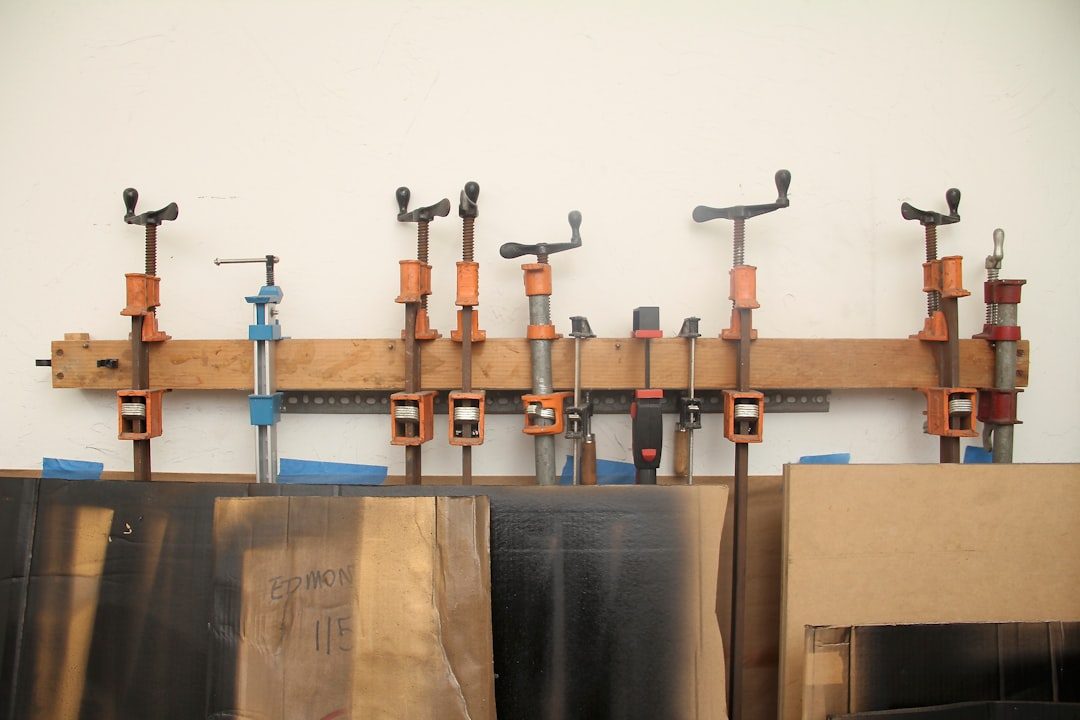
Clamps end up in a pile on the bench because nowhere else holds them, and a pile is where handles get bent and threads get dinged against each other. A single rail of angled dowel pegs gets every clamp off the bench and onto the wall in the order you'll actually reach for them. This version holds eight, but the same rail extends along a longer run of wall if you own more.
What you need
Step by step
-
Cut the rail to length: from the 2.4m length of 25 x 70mm PAR softwood, cut one piece to 1200mm on the miter saw, squaring both ends.
15 min -
Mark eight peg centres along the face of the rail, 150mm apart, starting 75mm in from each end and roughly centred top to bottom on the 70mm width.
10 min -
Clamp the rail to the bench and drill each peg hole 18mm deep at a 20-degree upward angle, using an 18mm brad-point bit. A wedge of scrap under the drill, or a doweling jig, keeps the angle the same across all eight holes.
30 min -
Cut the dowel rod into eight 90mm pegs on the miter saw, cradling the rod in a V-block or clamping it to a backer board for each cut so it can't roll under the blade.
20 min -
Sand a light chamfer on the exposed end of each peg so a clamp's jaw slides on without catching.
10 min -
Glue each peg into its hole with PVA, tapping it home with a mallet until it seats, and wipe off squeeze-out before it skins over.
15 min -
Find and mark the wall studs where the rack will hang, then drill clearance holes through the rail near its bottom edge at each stud location.
15 min -
Screw the rail to the studs, checking it's level before fully tightening.
15 min -
Hang the clamps, giving the heavier bar and pipe clamps the pegs nearest a stud.
10 min
Afterwards
Vacuum the sanding dust rather than blowing it off the bench. Give the glued pegs a full 24 hours to cure before hanging anything heavier than a spring clamp, and check each peg is still tight in its hole before loading pipe or bar clamps, since they put the most leverage on the joint.
Questions
Will the pegs hold heavy pipe clamps?
Yes, once the glue has fully cured — a pipe clamp's fixed head hooks over the peg the same way an F-clamp's does. Give heavier clamps the pegs nearest a stud, where the rail flexes least.
What if a stud doesn't line up where I need a screw?
Shift the whole rail sideways a little first — a few centimetres rarely matters for a peg rack — and only reach for a wall anchor rated for the load if you genuinely can't land at least three screws on studs.
Can I use softwood dowel instead of hardwood?
It will work loose sooner under repeated hanging and lifting. Hardwood dowel — beech or oak — holds the glue joint and the wear from steel clamp jaws much better.
How many clamps will one rack actually hold?
Eight pegs at 150mm spacing takes eight clamps comfortably, or more if you hang narrow F-clamps two to a peg.