A Roofed Softwood Firewood Storage Rack
- Hands on
- 265 min
- Start to finish
- 5 hours
- Level
- moderate
- Makes
- one 1200 x 500mm freestanding firewood rack, holding about a third of a cord
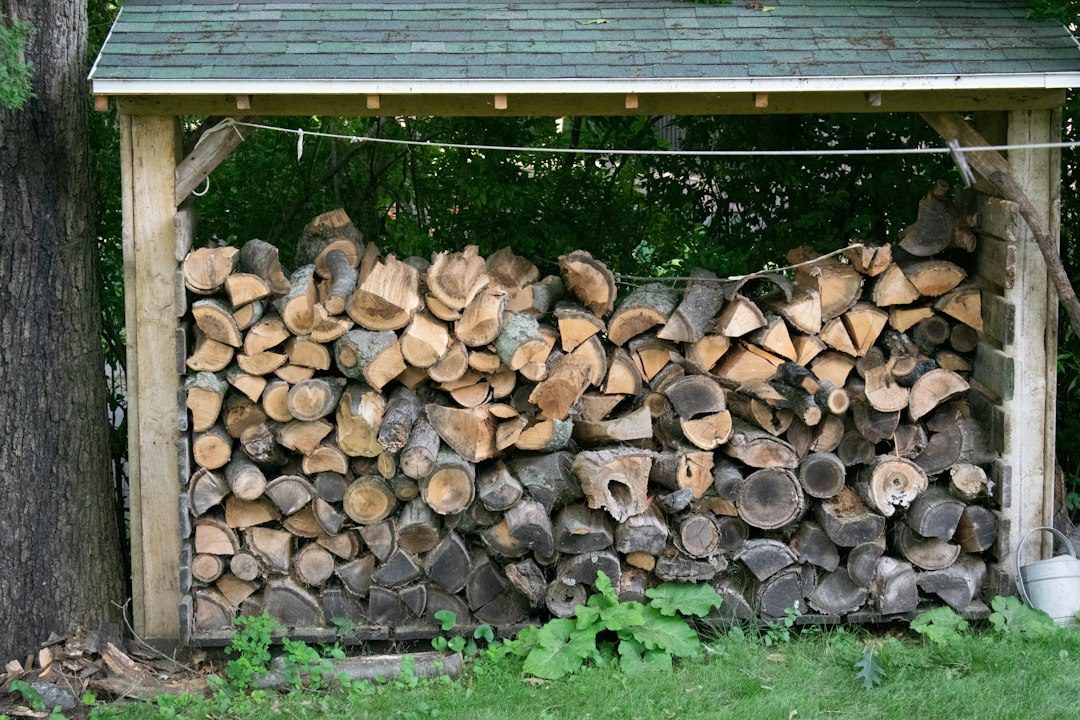
Firewood seasons and burns better kept off wet ground and out of standing rain, but a full woodshed is more than most gardens need or most weekends allow. This rack does the same job at a fraction of the size: two ladder-frame ends raised on treated runners, braced across the back, under a single sloped roof that throws rain clear of the stack. Built at 1200 x 500mm it holds roughly a third of a cord — enough split logs and kindling to bridge a couple of weeks without restocking — and it is small enough to stand against a shed wall, fence or garage without asking for space you don't have.
What you need
Step by step
-
Cut the two base runners to 1200mm from the 47 x 100mm pressure-treated stock, and lay them on the ground or paving 500mm apart and parallel, marking where each end frame will sit.
20 min -
Cut the four legs from the 47 x 75mm stock: two back legs at 1350mm and two front legs at 1200mm.
15 min -
Cut the two bottom rails oversized at 500mm and stand a back leg and a front leg upright on a flat surface at their finished height apart; lay a bottom rail across the feet and mark the leg angle directly off the assembly rather than trusting a calculated angle.
30 min -
Cut both bottom rails to the marked angle and screw each into its leg pair, forming two right-trapezoid end frames.
25 min -
Repeat the same direct-marking method for the two top rails, holding the legs at their working height and marking the slope where each rail crosses the legs; cut to the mark and fix in place.
30 min -
Cut and fit a diagonal brace inside each end frame, running from the base of the front leg to partway up the back leg, to stop the frame racking sideways.
25 min -
Stand both end frames on the runners 1200mm apart, square them with a combination square, and screw through the runners into the bottom rails.
20 min -
Cut six back slats to 1200mm from the 25 x 100mm lath and screw them across the back of the two end frames, evenly spaced from the bottom rail to the top rail, to brace the rack and keep split logs from falling out the back.
35 min -
Cut two roof bearers to 1200mm and screw them across the tops of the end frames, one at the front edge and one at the back edge, so the roofing sheet has something to land on at both ends.
20 min -
Cut the corrugated sheet to overhang the front bearer by 100mm, and screw it down through the ridges — never the troughs — into both bearers with the washered roofing screws.
30 min -
Brush exterior wood preservative onto every cut end, screw the back top rail into a wall, fence post or shed stud so a loaded rack cannot tip forward, then brush out the inside before stacking wood.
15 min
Afterwards
Brush bark and dust out of the rack before loading it, and brush exterior wood preservative onto every cut end, since factory treatment does not reach wood you've just cut through. Check the wall or fence fixing after the first couple of loads — a full rack settles as the timber takes the weight. Left alone, the pressure-treated stock will silver within a season; that's cosmetic and doesn't affect how the rack works.
Questions
Do I need to treat the timber if it's already pressure-treated?
No, but treat any cut end with preservative — pressure treatment protects right through the timber, but cutting it exposes untreated core at that face.
How much wood will it actually hold?
At 1200 x 500mm stacked to about 1200mm high, that's roughly a third of a cord — two to three weeks of burning for an average stove.
Can I build it longer than 1200mm?
Yes, but add a third end frame in the middle for anything over about 1800mm, since an unsupported sheet that long will sag under snow load.
Does the roof have to be corrugated PVC?
No — corrugated bitumen sheet sheds rain the same way and cuts more easily with hand tools. Either works as long as it's screwed through the ridges, not the troughs.