A Softwood Sawbuck for Bucking Firewood by Hand
- Hands on
- 150 min
- Start to finish
- 2.5 hours
- Level
- easy
- Makes
- one sawbuck, roughly 750mm long and 650mm high, rated for logs up to about 300mm across
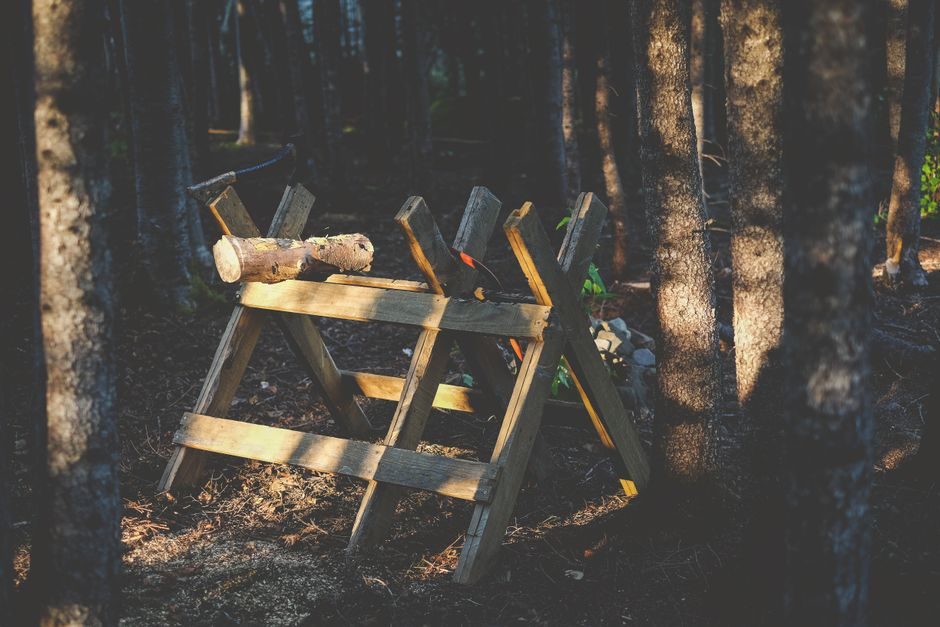
A sawbuck is two X-shaped trestles joined by a pair of rails, pitched so a log sits in the crotch of the X instead of rolling underfoot. It turns bucking firewood from a fight with a log on the ground into a job you can do standing up, at a height that suits a bow saw or a hand saw. This one uses construction lumber, four carriage bolts, and no joint more complicated than a crossed lap.
What you need
Step by step
-
Cut eight legs to 750mm long, with a 15-degree angle at one end of each so the frame sits stable and splayed rather than square.
20 min -
Pair the legs into four X-frames. Lay two legs crossed at roughly the midpoint, angled ends pointing outward and down, and mark where they overlap.
15 min -
At each marked overlap, cut a lap half the thickness of the stock out of each leg so the two sit flush when crossed, rather than stacked.
40 min -
Glue and bolt each crossing through the centre of the lap, one carriage bolt per X, nut and washer on the underside, tightened enough to stop rocking but not so tight the joint can't pivot slightly while you set the splay.
20 min -
Stand two X-frames up, splayed to the same width front and back, and check they sit flat without rocking on the floor. Trim a leg tip if one is proud.
10 min -
Screw the top rail across the two X-frames, through the crossing point of each, so the frames are held upright and parallel.
15 min -
Screw the bottom rail across the frames near the foot of the legs, tying the base together and stopping the frames from splaying further under load.
15 min -
Check the sawbuck stands level and doesn't rock on all four feet; pack or trim a leg if it does.
10 min -
Round over sharp edges on the legs and rails with a block plane or sandpaper so nothing catches a sleeve while you work.
10 min
Afterwards
Brush off sawdust and bark after each session so it doesn't hold damp against the joints. Left outdoors, softwood legs will grey and eventually split at the end grain; a coat of exterior wood finish extends its life, but it isn't essential for a fixture this cheap to rebuild. Check the bolted crossings once a season and retighten if the frames have started to rock — that's the joint doing the work, and a loose one is what lets a log shift mid-cut.
Questions
Why bolt the crossings instead of just screwing them?
A bolt lets you set the splay before final assembly and clamps the lap tight without splitting the thin cross-section a screw would bite into. It also holds under repeated racking load better than screws alone.
Can I make it taller for cutting standing fully upright?
Yes — scale the leg length and keep the same 15-degree splay. Past about 750mm the frame needs a wider base or it will tip sideways under an off-centre log.
What size log is this good for?
Up to about 300mm across sits well in the crossing. Bigger than that, the log rides too high above the V and it's back to sawing on the ground.