A Pine Peg Rail
- Hands on
- 115 min
- Start to finish
- 5 hours
- Level
- easy
- Makes
- one 900mm peg rail with five hooks
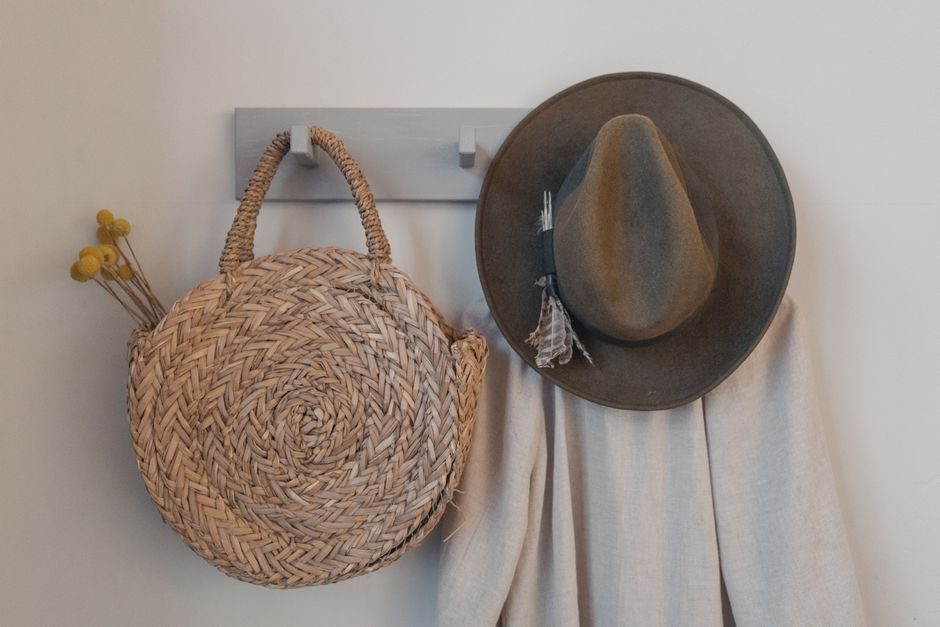
A peg rail works the moment the first coat goes up. The whole job is one board, five pegs, and two screws into the wall. The board is drilled at 5° so the pegs tip forward just enough to hold a bag without looking like they are falling. Shaker pegs from a woodworking supplier give the cleanest look; screw-in metal coat hooks from any hardware shop are quicker to fit and skip the angled drilling stage entirely. Either way, the board, the hole layout, and the wall fixing are the same.
What you need
Step by step
-
Crosscut the pine to 900mm. A miter saw makes this a single pull; a tenon saw against a bench hook works just as well for one straight cut. Hold the board against the fence and stand clear of the blade line.
10 min -
Mark five peg positions along the face: 75mm from each end, then one every 150mm between them. Each mark should be centred on the board's 90mm width — 45mm from either edge. A marking gauge or a combination square keeps this honest.
5 min -
Shim the back edge of the board up by about 8mm (a scrap of 18mm pine under the back, resting on the bench, tilts the face 5° toward you). Clamp the board in this position. Bore a 22mm hole to 25mm depth at each mark, keeping the drill vertical — the board's tilt gives the pegs their forward lean. Clear shavings from the bit between holes.
20 min -
Mark and bore the two mounting holes: 50mm in from each end, centred on the board height. Countersink them so the screw heads sit 3mm below the surface — they will be hidden once the rail is on the wall.
10 min -
Test-fit each peg dry; it should push in with firm hand pressure and stay put. If a peg drops in freely, wrap the tenon once with a few turns of thread before gluing. Squeeze a small spot of PVA into each hole, push the pegs home, and wipe squeeze-out before it skins over.
15 min -
Set the board aside for 30 minutes while the glue sets. Then sand the face and front edges with 120-grit, followed by 240-grit. Ease the top and bottom front edges lightly with a folded piece of 240-grit to remove the sharp arris.
25 min -
Apply two thin coats of oil or wax, 30 minutes apart. Wipe off any excess before it goes tacky. Let the second coat cure fully before hanging the rail.
10 min -
Hold the rail at the intended height, level it with a spirit level, and mark the two fixing holes on the wall. Probe for studs with a stud finder or bradawl; if you find timber, drive the No. 10 × 70mm screws directly in. If not, fit rated hollow-wall anchors first. Snug the screws down firmly — do not overtighten or you will strip the fixing.
20 min
Afterwards
Dust with a dry cloth. Re-oil or re-wax once a year. Check the wall fixings each autumn before heavy coats go back up — anchors in plasterboard occasionally work loose and are worth re-tightening before they become a problem. If a peg has worked loose, pull it out, clear the hole of old glue with a narrow chisel, re-glue, and clamp the board flat overnight.
Questions
Where do I find Shaker pegs?
Woodworking suppliers carry them — Axminster and Workshop Heaven in the UK, Rockler and Woodcraft in North America. The 22mm size fits most uses. Screw-in metal coat hooks from any hardware shop do the same job and are often easier to find; skip the angled drilling stage and just drive them into pre-drilled pilot holes.
How deep do the holes need to be?
25mm minimum. Most Shaker peg tenons are 20–22mm long, so at 25mm you have a small glue reservoir beyond the tenon end, which is what locks the peg. Shallower than the tenon length and the peg relies on friction alone — it will eventually work loose.
What if I cannot find a stud?
Use hollow-wall cavity anchors or toggle bolts rated for at least 20kg per fixing point. Probe the wall before committing — a bradawl pushed through plasterboard will hit timber if a stud is behind it. Two solid fixings matter more than their exact position, so adjust the board's horizontal placement to hit the studs if you find them.
Can I make the board longer or shorter?
Yes. Add or remove pegs in 150mm increments and adjust the board length to match, keeping 75mm of timber beyond the outermost peg at each end so the fixing screws have solid wood around them. For a very long rail, add a third fixing point in the middle rather than relying on two widely spaced screws.