An Elevated Wooden Dog Bed With a Canvas Sling
- Hands on
- 210 min
- Start to finish
- 27.5 hours
- Level
- moderate
- Makes
- one dog bed, 950 x 550 x 200mm, suited to dogs up to around 30kg
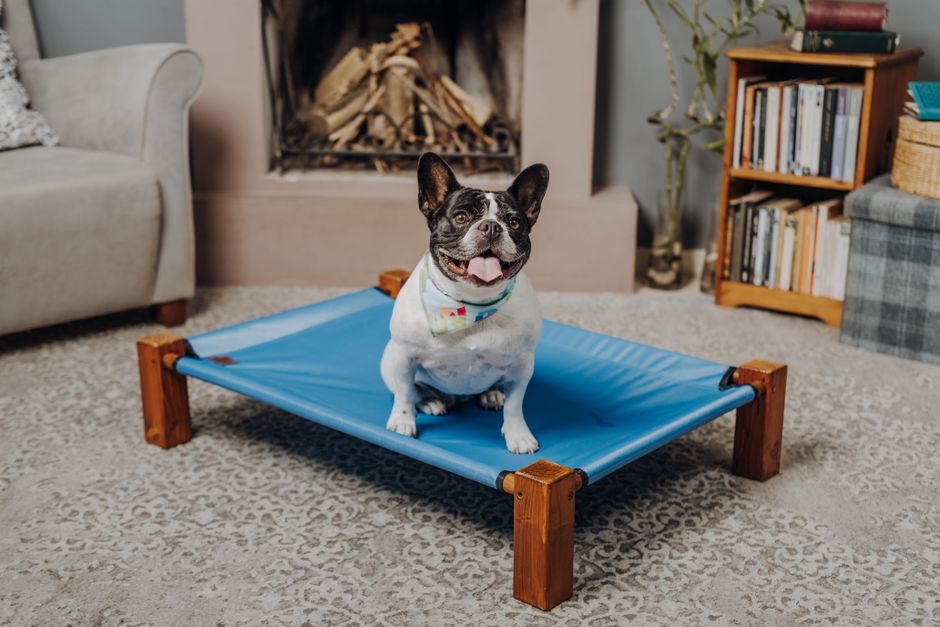
A dog on the floor is a dog in the draft, on cold tile or damp concrete. This bed lifts them clear of both with a simple rail-and-leg frame and a length of canvas stretched tight between the two long rails, the same principle as a director's chair seat. There is no cushion foam to compress or fabric-covered bed to hold moisture: just a wipeable frame and a sling that unscrews for washing.
What you need
Step by step
-
Cut the four legs to 200mm long from the 44 x 44mm stock on the miter saw.
15 min -
Cut the two long rails to 860mm and the two short rails to 460mm from the 70 x 20mm stock, then cut the two battens to 860mm from the lath.
20 min -
Mark the rail position on each leg with a combination square so the top edge of every rail will sit flush with the top of the leg, and mark two screw positions near each rail end.
15 min -
Build two matching side units: glue and clamp a long rail flush to the top of two legs, on the inside face, then predrill, countersink and screw through the rail into each leg.
30 min -
Stand the two side units up facing each other and join them with the short rails at the front and back, screwed into the adjacent inside faces of the legs. Check the diagonals match before the last screws go in, so the frame ends up square rather than a parallelogram.
30 min -
Sand the whole frame, easing every edge the canvas or the dog will touch, and round over the top outer corner of each leg.
20 min -
Cut the canvas panel to roughly 950 x 650mm, with the long edges running across the width, the ones that will wrap the two long rails.
10 min -
Fold one long edge of the canvas over one rail, pull it taut by hand, and staple it to the top face of the rail every 50mm.
15 min -
Repeat on the other rail, pulling the canvas fully taut before stapling — whatever sag is left now is the sag the dog will sleep in.
15 min -
Screw a batten over each stapled edge, sandwiching the canvas between batten and rail so the load sits on wood and screws rather than on the staples.
20 min -
Finish the frame if it will live outdoors or somewhere damp, or leave it sanded bare or varnished for an indoor bed, and let it cure fully before use.
20 min
Afterwards
Vacuum sawdust off the frame before fitting the canvas so it doesn't work its way underneath. If you've oiled the frame, check the tin for cure time but allow at least a full day before the bed takes any weight. After the first week of use, check the batten screws for tightness, and again every few months — a dog climbing on and off works fixings loose faster than most furniture. The canvas unscrews from the battens for washing; keep the frame itself away from a washing machine.
Questions
Can I use plywood instead of a canvas sling?
You can build a solid platform instead, but you lose the airflow underneath that keeps a dog cooler in summer and helps a damp coat dry after a wet walk — the sling is the point of this design.
What fabric actually holds up?
A heavyweight cotton or poly-cotton duck canvas, at least 400gsm, sold as outdoor upholstery or awning fabric. Anything lighter will stretch and start to sag within weeks of daily use.
Is this sturdy enough for a large dog?
At these dimensions it suits dogs up to around 30kg. For anything heavier, move up to 45 x 45mm legs and add a centre rail under the canvas span to stop it bowing.
Does it have to stay indoors?
It's fine on a covered porch if the frame is oiled, but let the canvas dry out fully between uses — canvas that stays damp will mildew.