A Laminated Beech Knife Block
- Hands on
- 160 min
- Start to finish
- 2 days
- Level
- moderate
- Makes
- one five-slot beech knife block, about 140 x 120 x 185mm
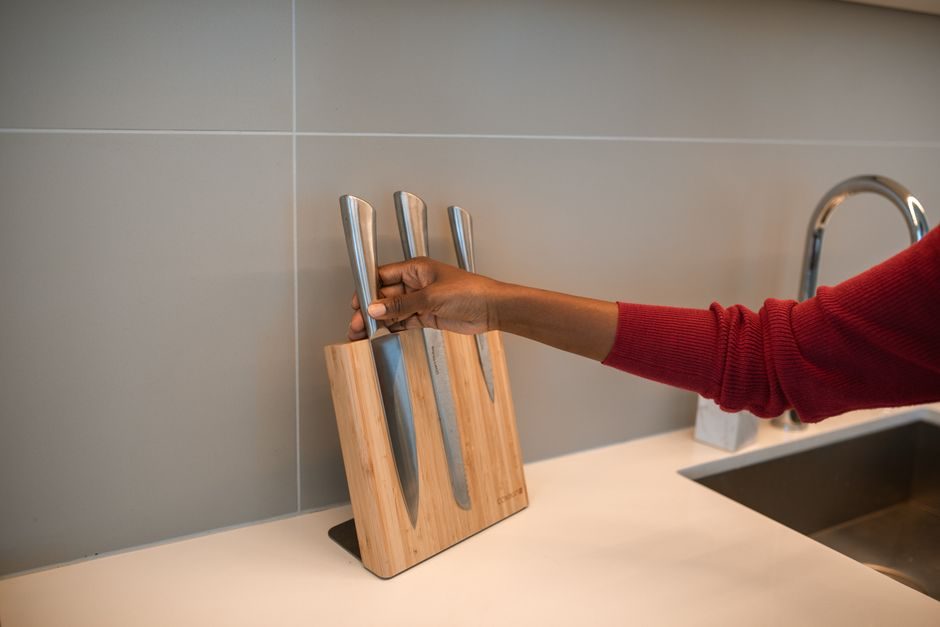
This block gets its slots from strips and spacers rather than from cutting into solid wood: alternating hardwood strips with taped, removable spacers, gluing the stack, then working the spacers free once the glue has cured. Every slot ends up the same width and perfectly parallel, using nothing more than a miter saw and a set of clamps.
What you need
Step by step
-
Mark and cut six strips 190mm long from the 20 x 120mm beech, clamping a stop block to the miter saw fence so all six come out identical.
20 min -
Cut five spacers 190 x 120mm from the 4mm plywood, then wrap each one completely in packing tape, shiny side out.
20 min -
Dry-stack the six strips and five spacers alternately, strip-spacer-strip, and check the stack sits flush and square before committing to glue.
10 min -
Spread glue on both faces of each strip only, leaving the taped spacers glue-free, then rebuild the stack in the same order.
10 min -
Clamp the stack evenly across its width with a caul at each end to keep every strip flush, and wipe off squeeze-out before it skins over.
15 min -
Leave it clamped for the glue's full clamping time, then leave the block a further day before handling it hard.
-
Unclamp and work each taped spacer free, pulling it firmly or tapping it from the wide end against a block of scrap wood, leaving five parallel slots through the block.
15 min -
True the top, bottom and both ends square on the miter saw, trimming only a millimetre or two off each face.
15 min -
Sand every face and the inside of each slot to 240 grit, easing the sharp arrises so the block is comfortable to pick up.
25 min -
Glue and clamp the base centred under the block with a small overhang on every side, and leave it to cure.
15 min -
Apply a food-safe board oil to the whole block, wiping off the excess after the time stated on the tin, and stick felt pads to the underside once the oil has cured.
15 min
Afterwards
Vacuum sanding dust rather than blowing it around, and wipe the block clean before oiling. Let the glue cure fully before working the spacers free or trimming the block, and let the food-safe oil cure for the time stated on the tin, usually a full day, before the block goes near food. Re-oil every few months once the wood starts looking dry, and check the felt feet have not lifted.
Questions
Why glue up strips instead of cutting slots into a solid block?
Cutting narrow, parallel slots cleanly needs a slot-cutting jig most home shops do not have. Building the slots from strips and removable spacers gives identical, parallel slots using only a miter saw and clamps.
A spacer will not come out, what now?
Check that glue did not creep onto the taped spacer face during clamping. Tap the strip next to it, not the spacer itself, from the wide end against a block of scrap wood, working both ends alternately rather than forcing one end.
Will this fit a large chef's knife or a cleaver?
A 4mm slot suits most kitchen knives up to a wide chef's knife. For anything wider, make one or two spacers thicker before you glue up. Measure the actual blades you own rather than guessing.
Can I use pine instead of beech?
Yes, though pine dents more easily at the slot edges over years of use. Both work fine with an oil finish; beech simply wears harder.